Today marks the end of my 13th quarter at UCSD (not counting summer), with two more to go before I finish my Master’s. I have plenty of opinions about UCSD in general, but one thing I’ve never fully settled on is how I feel about the quarter system.
UCSD runs on quarters: three main academic terms a year, each about 10 weeks long (summer sessions are about 5 weeks, which is a whole other story). This is different from the semester system used by many universities, where there are usually two main terms a year, each around 15 weeks.
There are a lot of strong opinions about quarters. Some people love it because you get exposed to more topics. Others hate it because the pace never lets up. Personally, I’m stuck in the middle.
A quick reality check: the quarter “timeline” (as it actually feels)
WEEK 1  : optimism + “this quarter I’m going to be so on top of it”
WEEK 2  : first assignments hit + you realize every class moves fast
WEEK 3  : the panic midterm (or “quiz that’s basically a midterm”)
WEEK 4  : you either stabilize… or quietly start falling behind
WEEK 5  : the point of no return (deadlines multiply; you triage your life)
WEEK 6  : “I’ll catch up this weekend” (you will not)
WEEK 7  : second wave of exams/projects (and your calendar becomes fake)
WEEK 8  : everyone disappears socially
WEEK 9  : pure momentum + coping mechanisms
WEEK 10 : damage control + “just get me to finals”
FINALS  : one last sprint, then immediate amnesia and recovery
That pattern isn’t universal, but it’s common enough that it shapes how students plan their lives—especially if you’re also doing research, working, or trying to stay involved outside class.
Why I don’t like the quarter system
Fundamentally, I don’t love how much quarters limit what can realistically be covered in a class. On paper, you have 10 weeks. In reality, it often feels like you have 6–7 weeks of “real runway” once you account for onboarding, midterms, project deadlines, and finals. The compression forces a lot of classes into one of two shapes:
- Very broad “survey” courses (often branded as “Introduction to…”), where you touch a lot of ideas but don’t have time to go deep.
- Very niche courses, which can be amazing if you’re interested—but those aren’t always offered consistently, especially if demand fluctuates.
Some departments solve this with multi-course sequences, but that comes with tradeoffs too. Committing multiple quarters to a sequence can mean giving up other areas you could’ve explored—and you have to care a lot to keep choosing the same topic again and again.
The stability problem (especially with extracurriculars)
The other big downside is stability. I’ve watched the same cycle happen over and over:
- Weeks 1–4: people overestimate how much they can commit to, underestimate how fast classes ramp up, and start slipping.
- Weeks 5–10: midterms/finals stack up, and extracurriculars get dropped so everyone can catch up.
A semester system usually gives you more time to settle into a rhythm before assessments and major deadlines really dominate. One of my favorite quarter “exceptions” was CSE 260, which (for some odd reason) had a midterm in Week 7. That was genuinely nice: people had time to adjust before getting tested.
I’m not alone in feeling this
If you skim r/UCSD or student writing about UCSD academics, the same themes show up again and again.
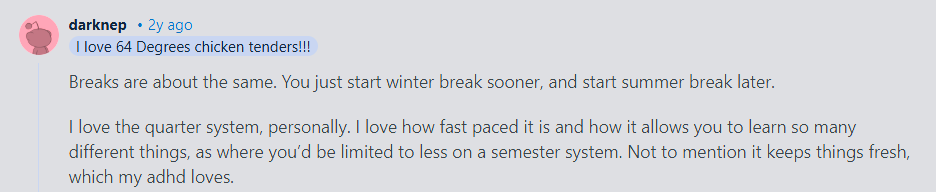
On the pro-quarter side, one student summed up the appeal as: “I love how fast paced it is… it keeps things fresh.”
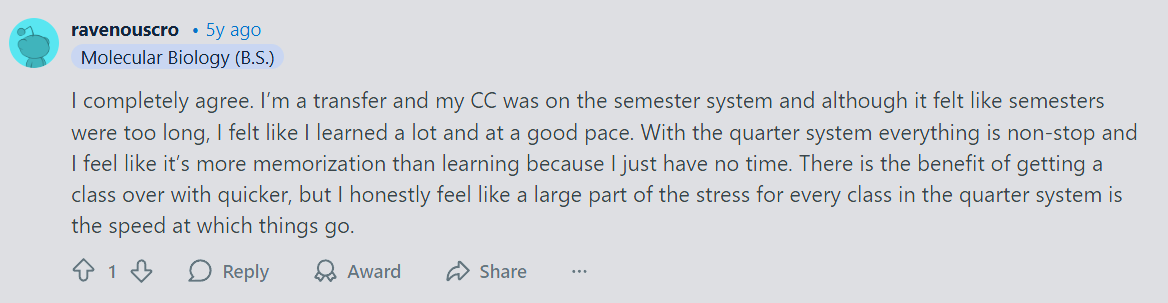
On the other end, a transfer student described the downside bluntly: “With the quarter system everything is non-stop… it’s more memorization than learning.”
And The UCSD Guardian put the vibe into a single sentence: “I think everyone knows that it’s a very rushed system.”

Reading those takes doesn’t “prove” anything, but it does make the experience feel less like a personal failing and more like a predictable consequence of the structure.
The upsides (because there are some)
To be fair, quarters have real advantages.
You simply take more classes over your time here, which means you get exposed to more topics and more subfields. And there’s something psychologically nice about how short the terms are—counting down 10 weeks is easy, and the finish line is always close. Sometimes that makes the pace feel energizing rather than exhausting.
What I wish I knew in my first quarter
I wish someone had told me to treat a quarter like a rolling sprint, not a marathon: assume Week 3 is “midterm season,” plan your life accordingly, and commit less than you think to extracurriculars until you’ve seen the workload of each class. The best quarter-system skill isn’t intelligence—it’s starting early, because in a 10-week term there’s basically no “later” that won’t immediately collide with another deadline. One quote every single computer science class mentions is "start early, start often"—it’s cliché, but it’s cliché for a reason.
Where I land
If I could choose, I’d prefer a semester system over the quarter system—but I also don’t care enough to campaign for it.
A big reason is that, for me, the deepest learning at UCSD has happened outside traditional classes: research and personal projects. Classes still matter (they expose you to ideas you can reuse later), but they often don’t feel like the main event.
This could be a separate post, but I also think UCSD doesn’t always do enough to pull students into those deeper opportunities. In my experience in the CSE master’s world, it can feel like the system mostly measures “classes completed,” and everything else (research, internships, serious projects) is something you have to proactively hunt down yourself—rather than something structurally built into the path.